Posted by Team rankifygenius
Filed in Arts & Culture 2 views
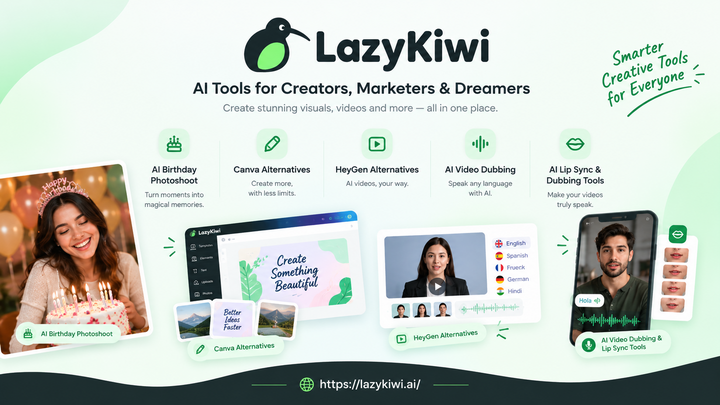
An AI birthday photoshoot uses one uploaded photo and an AI image or template tool to generate multiple styled birthday portraits — different backdrops, lighting, and looks — without a photographer, studio, or outfit change. Free tools like LazyKiwi let you upload a single selfie, pick a portrait template or type a prompt, and download several finished images in under a minute, all inside a browser.
There's a reason "studio-quality" birthday photos used to mean booking someone, picking a date, and hoping the weather or your skin cooperated. That's no longer the bottleneck. The bottleneck now is knowing which AI photo tool actually gives you a clean, usable result from a normal phone photo — and which ones just slap a filter over your face and call it a shoot.
I've spent enough time inside AI photo and video generation workflows to know the difference is almost always in two things: how the tool handles your actual face (does it still look like you after three edits?), and how many finished looks you get per photo you upload. Most birthday-photoshoot searches are really asking: can I skip the photographer this year and still get something worth posting? Yes — and by the end of this article you'll know exactly how to do it, what tends to go wrong, and which style choices actually read as "photoshoot" instead of "filter."
A free ai birthday photoshoot is not one image — it's a small set of them, generated from a single source photo, styled around a theme (a backdrop, an outfit, a lighting setup) so they read as a coordinated shoot rather than a one-off edit.
Every credible tool in this category works from the same three ingredients, just packaged differently:
A clear source photo — front-facing, decent lighting, no sunglasses or heavy shadow across the face.
A style direction — either a pre-built template (a specific backdrop, pose, and color grade already configured) or a written prompt describing the scene.
A generation engine — the actual model doing the work. This is the part most people never think about, and it's the part that determines whether you still look like you afterward.
A blurry or heavily cropped source photo is the single biggest reason people get disappointing results and blame the tool. The model has less face data to work with, so it fills gaps with its own guesses — which is where you start seeing the wrong eye color, a jawline that isn't yours, or skin texture that looks airbrushed into plastic. One clear, front-lit photo — even a normal phone selfie — consistently outperforms a "professional" photo taken at an odd angle.
Most articles on this topic list features. Here's the sequence that actually produces a usable set of birthday photos, using LazyKiwi's image generator and template library as the working example, since it's built specifically around one-photo-in, styled-output-out generation.
Free AI Tool Like Canva explore free AI-powered design tools that help you create stunning graphics, social media posts, presentations, and more without expensive software.
App Like Canva discover creative apps like Canva that offer easy-to-use templates, AI design features, and powerful editing tools for beginners and professionals.
LazyKiwi gives you two paths from the same account and credit balance:
Templates, where the model, prompt, and lighting are already dialed in — you upload a photo, tap the template, done. Templates like Sakura Room Portrait, Stadium Fan Portrait, Reference Style Portrait, and Seaside Blue Hour are built for exactly this kind of single-photo styled portrait, and they generalize well to party and celebration looks even though none are labeled "birthday" by name.
Text to Image, where you type the scene yourself — "birthday portrait, gold confetti falling, warm string lights, studio lighting, 35mm film look" — for full control when no template matches your vision.
One good photo is enough. Uploading multiple angles doesn't currently improve consistency on most template-based tools — it just spends more credits. Start with your single best shot.
Run the same template or prompt 3-4 times before judging the tool. AI image generation has natural variance — the second or third output is often noticeably better than the first, especially for hands, jewelry, or text on cake/signage if those are in frame.
If the output is 90% right but the earrings look fused to the ear, or the cake candle count is wrong, don't scrap the image — most tools let you regenerate just that detail or swap in a different variation from the batch rather than starting over.
This was true in 2023. It is not reliably true anymore, and treating it as a rule leads people to either avoid a genuinely useful free option or accept a worse result out of habit.
According to a 2026 industry analysis, roughly 71% of consumers now believe AI-generated images are common on social media — meaning the audience's default assumption has already shifted from "this is obviously fake" to "this might be AI, and that's fine." Separately, around 20% of Americans reported having used AI to generate an image or video as of 2024, and that adoption curve has only steepened since. The stigma that made "AI photo" synonymous with "uncanny valid" has mostly worn off because the models improved and the audience got used to seeing the output.
What still gives away a weak AI photo isn't that it's AI — it's inconsistent lighting direction between the face and the background, hands with the wrong finger count, or skin that's been over-smoothed. Those are model-quality and prompt-quality problems, not "AI" problems. Pick a tool that handles faces well, generate a few variations, and the "it looks fake" objection mostly disappears.
This is the section most comparison articles skip, because it's more useful to readers than it is flattering to a "just upgrade" sales pitch.
On a free tier across most AI photo tools, including LazyKiwi, you typically get:
A capped number of starting credits with no card required
Full access to the template library and image generator
Standard-resolution downloads
What you usually give up by staying free:
Volume — free credits run out faster than people expect once they start batch-generating (see Step 3 above). If you want 10+ variations across multiple templates, budget for that.
Commercial usage rights — free output is typically fine for personal social posts; paid tiers are what cover commercial use if the photos are going into paid ads, client work, or a business account.
Priority generation speed during high-traffic windows.
Honest take: for a personal birthday post, free is genuinely enough. For a business, brand account, or paid campaign built around AI photoshoot content, budget for a paid tier from the start rather than hitting a credit wall mid-project.
This part rarely gets covered, and it's increasingly relevant. When someone asks ChatGPT, Perplexity, or Gemini's AI mode "how do I make AI birthday photos for free," those systems pull from pages that answer the question directly and specifically — not from pages padded with generic AI-photography history.
The pages that get cited by generative engines in this category tend to share three traits: a plain-language direct answer near the top (not buried after 400 words of preamble), specific named tools and named limitations rather than vague "many apps offer this" language, and an honest treatment of trade-offs rather than pure promotion. That last point is counterintuitive for a lot of SEO content — the more a page reads as balanced and specific, the more citable it becomes, because AI systems are optimizing for giving their own users an accurate, trustworthy answer, not a sales pitch.
A simple four-check framework to run before you trust any AI birthday photoshoot output, whether you use LazyKiwi or something else. Bookmark this — it applies to any AI photo tool, not just ours.
|
Check |
What to Look For |
Fix If It Fails |
|
Face Fidelity |
Does it still look like the same person, especially in a 3-second glance? |
Regenerate with a clearer, more front-facing source photo |
|
Light Match |
Does the light direction on the face match the light direction in the background? |
Pick a template/prompt with lighting closer to your source photo's lighting |
|
Detail Integrity |
Hands, jewelry, text (cake, signage, balloons) — anything with fine structure |
Regenerate that variation or crop the detail out of frame |
|
Usage Fit |
Personal post vs. paid/commercial use |
Confirm your account tier covers the intended use before publishing |
If an image passes all four, it's ready to post. If it fails Face Fidelity or Light Match, no amount of editing saves it faster than just regenerating — that's the single most time-efficient fix in this whole workflow.
Neither option wins every scenario, and pretending otherwise isn't useful to you.
AI wins on: cost (free or a few dollars vs. hundreds), turnaround (minutes vs. scheduling a shoot), and volume (generate a dozen looks vs. paying per look).
A photographer wins on: guaranteed accuracy of small physical details, group shots with more than two or three people, and any situation where the final image needs to hold up at large print size or professional scrutiny.
For a birthday post, story, or invite graphic, AI is very often the better tool for the job simply because the bar for "good enough" is a phone screen, not a gallery wall.
How do I do an AI birthday photoshoot for free? Upload one clear, front-facing photo to a free AI photo tool like LazyKiwi's image generator or template library, pick a portrait-style template or write a short scene prompt, and generate 3–4 variations. Free accounts typically include starting credits with no credit card required, covering several generations before you'd need to upgrade.
What's the best free AI tool for birthday photos? The "best" one depends on whether you want a quick, pre-styled result (a template-based tool) or full creative control (a prompt-based image generator). Look for a tool offering both from one account, no card requirement, and a template library built around single-photo portraits rather than group scenes or product shots.
Why does my AI birthday photoshoot not look like me? Usually the source photo — blurry, poorly lit, angled, or cropped tightly enough to lose facial reference points. Upload one clear, front-facing, well-lit photo and regenerate rather than trying to fix a bad-source result with prompt tweaks alone.
Can I use AI birthday photos commercially, like for a business account or paid ad? It depends on the platform's tier. Free tiers on most AI photo tools are intended for personal use; commercial usage rights — needed for ads, client work, or brand accounts — are typically part of a paid plan. Check the specific tool's terms before publishing commercially.
Is an AI birthday photoshoot the same as a Snapchat or Instagram filter? No. A filter applies a real-time overlay to live video or a photo you already have, changing surface details like color or adding a graphic layer. An AI photoshoot generates new images from your source photo using a diffusion or generative model, which can change lighting, background, pose, and styling far beyond what a filter overlay can do.
Do I need editing skills or Photoshop to make AI birthday photos? No. Template-based AI photo tools are built specifically so no editing skills are required — you upload one image, select a template, and download the result. No layers, no timeline, no manual retouching needed for a usable result.
If you're deciding whether an AI birthday photoshoot is worth trying this year, the honest answer is: yes, for the price of one clear photo and a few minutes, and it's genuinely good enough for a social post, invite, or story. The part that actually determines your result isn't which app has the most templates — it's starting with a clean, front-facing source photo and generating a small batch of variations instead of judging the tool off a single try. Run the four-point readiness check above before you post anything.
If you want to try it, LazyKiwi's image generator and portrait template library start free with no credit card, and you can be looking at finished variations in the time it takes to read one more article about which app is "best."
Bookmark the readiness framework above — you'll want it again the next time any AI photo trend hits your feed, not just for birthdays.



